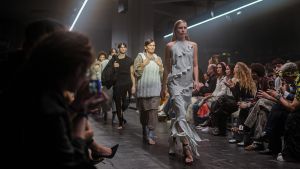





HFDA Academy: New View | Episode 9 | E-commerce in a changing environment
How should creative industry professionals react to changing consumer needs?
The Coronavirus pandemic has brought along change, including the radical change of previous consumer habits. Due to social distancing, shopping in stores has drastically decreased and instead, retail has moved to the online sphere. Furthermore, changes have taken place in what and the quantity of what the audience is buying, which is why it is very important for the fashion and design industry to rethink and replan how it will relate to its target audience in the upcoming near future.
After the first shock, the solution was the fast transformation of marketing and sales strategies and to adapt to changed customer habits. Everyday life has shifted to the online space, and instead of huge purchases, now everyone has enough time to find the specific products that best suit their needs and make an informed decision on buying them. It has become visible, that there is a much greater need for brand awareness, transparency and the forging of personal relationships. Current competitiveness depends on both business decisions and appropriate cost allocations, as well as designing creative revenue opportunities during this challenging period - of which one leg is clearly a properly redesigned marketing strategy.
Can online sales attract a wider audience?
Sales professionals know that in difficult situations there are many opportunities for a solution. In the current circumstances, everything is happening online, and the behaviour of potential buyers can be seen via the act of online shopping, which results in far more accurate, measurable statistics. One great technique is so-called user-generated content, in which consumers themselves take their share in building the brand. Another option is influencer marketing, which continues to be an excellent resource. Inviting the audience to engage, creativity, and authentic, transparent communication allows consumers to build trust in specific brands and their products. This is a relatively long process that requires patience, but in the long-run, producing consistently authentic content will pay off.
Businesses can use two approaches for the above:
- Strategic Approach:
Due to the changing economic environment, as a first step, companies and businesses have cut the costs of paid media ads, which means that there are now far fewer advertisers and more affordable ads to try on both Facebook and Google’s ad network. Those smaller brands that have previously only had fewer opportunities to run PPC campaigns due to their low budgets can now try these ad formats with even a small budget.
Besides conversion goals, it can be a great opportunity to test online advertising opportunities during this period with either a freelance professional or an agency. This will allow the relaunched economy to make more effective use of the advertising framework and also support the launch of targeted remarketing campaigns based on available data.
Before testing ads, it is very important that all background analytics are properly integrated into the website being used - Google Analytics, FB pixel - so that right from the start, ad performance and visitor behaviour can be continuously measured, and campaigns can be run accordingly.
- Emotional Approach:
Attention is now strongly being focused on the fate of our planet globally. The creation and shaping of a more sustainable world and lifestyle is already essential for consumers. Customer habits are becoming even more conscious and there is a strong demand for unique products from smaller brands in addition to mass-produced products by multi companies.
Is it worth considering a discount/sale for earlier and seasonal collections?
In the fashion segment, there are several perspectives to consider in terms of discount strategies related to online sales, depending on the brand’s business policy and market operation.
- Small and medium-sized brands, but also luxury brands all face the same problems regarding their significant inventory per season: the in-store sales for the current season have been a miss, sales for the next season are uncertain, and some wholesale orders have been cancelled, all leading to stockpiling. To keep losses to a minimum, for brands with a surplus inventory it’s still more worthwhile to sell at a margin loss due to the uncertain continuation, rather than leaving the merchandise entirely unsold in the current season. The goal is to generate as much profit as possible in the short-term, which can help reduce brand damage in the long-term. Strategically, short-term sales can be maintained for the current Spring-Summer Season, and longer-term off-season sales can be applied to certain themed product selections or to pieces left over from previous seasons.
- In the industry, the sale of unique, local designer products with just a few number of pieces is not yet recommended. If the brand doesn’t have a webshop, then direct sales on social platforms, a collaboration with other themed webshops or the usage of mobile application-based marketplaces can be a good strategy to complement the sales channels of brands with a larger inventory and their own webshop. The demand for quality has not changed, and with the restart of the economy, this demand will reappear, and online shopping will gain even more ground, with even more opportunities for brands. If possible, it’s worthwhile for smaller brands to wait and review their fixed and variable costs and then continue to operate their company in the coming months by reducing these costs.
- If they can, there are brands that will wait out and keep the remaining stock for this year’s Spring-Summer Season for 2021, by saving products to try and sell them for next year’s Spring-Summer Collection. This strategy is appropriate for brands where their collections are timeless and don’t consist of only trend-specific pieces.
How flexible should designers be?
It’s perhaps during this period, that it is the most necessary to be flexible and to be constantly monitoring changes in the market, even on a daily basis.
Speed, smart and creative thinking, monitoring opportunities and taking advantage of them both locally and internationally, is crucial, especially in the field of marketing. In the current situation, things can change within days, and the marketing message we are communicating today may be out of touch by tomorrow. Due to the current situation, people have got used to online shopping and online administration, so it is important that businesses pay attention to this even after the emergency has passed.
Can we move towards locally made handicrafts?
Over the last few weeks, production processes across Europe have either slowed down or come to a complete halt. Brands that work with local and ethical manufacturing can now benefit from this period, as the Epidemic has made people think about their customer habits, so as opposed to mass production, individual products and independent smaller brands will now have easier access to the market.
Customer demands are shifting towards unique quality, longer-lasting products, and consumers are much more open to brands with individual, transparent manufacturing processes. Customer awareness and sustainability go hand in hand, and the challenge for a brand producing a unique craft product will be to develop an online commercial model in the coming months.
How can I be competitive? Do I need to develop an application?
There may not be a better moment for creating an online sales platform than now. In the upcoming times, it is clear that the focus will be on digital solutions in sales. Whether a company is thinking of creating a webshop or developing a standalone application for its online sales channel, it is worth considering these moves as long-term plans. Further, it’s also recommended to look around on the local market, especially at reseller or aggregator webshops for mobile applications, and marketplaces for smaller brands with fewer products. Platforms that specialize specifically in custom craft products already have a stable target audience and sales channels, and make for an excellent opportunity besides the less certain direct sales on social media.
How can my web store be an unavoidable market player, and how can I acquire returning customers?
Multiple aspects need to work well together in an integrated way for the online trading environment to work optimally, and in the current situation, the most important aspect to consider is that the majority of the audience’s time is spent online.
- Technological Background
The webshop platform should be simple to use and easy to customize, it’s important to integrate multi-channel sales opportunities and various cloud-based marketing and other software and tools
2. Digital Presence - Site Loading
The vast majority of visitors visit websites from mobile devices, therefore it is very important that the interface can be used easily from a telephone.
What’s the difference between the domestic and the international market?
Due to rapid market change and the constant evolution of consumer habits, online luxury trading does not have time to develop winning strategies as the Coronavirus crisis fears a deep economic recession. This further accelerates the drastic and radical changes in consumer behaviour, which according to analysts could lead to further consolidation, shrinkage and further business closures in the online luxury market.
However, in the midst of a crisis, new opportunities may arise. A pandemic can provide an opportunity to change the accelerating seasonal pace of fashion, as season launches are continuously shifted to even earlier dates. It is not yet clear how this will affect the seasonal calendar, but this crisis point could be an opportunity for the fashion and design industry to also rethink its four-season structure.
A summary of the pro-publication in English is also available in a downloadable form here.
More articles
The Hungarian Fashion & Design Agency Continues Its Operations Under the Name Creative Hungary Nonprofit Zrt.
BCEFW Young Talents Designers Featured in the Design POP-UP by ELLE Selection