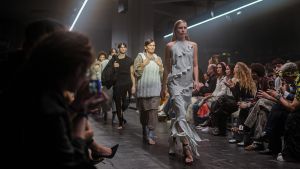





HFDA Academy: New View | Episode 18 I The pandemic’s effect on the fashion industry globally
Future of fashion – time for a change of attitude
The economic slowdown caused by the pandemic has also provided an opportunity for the fashion industry to find new ways for communication and sustainability. By bringing together the players in the profession, rethinking the relationship to discounting and creating modern communication messages, a new era can begin in the life of the fashion industry.
The first half of this year was undoubtedly about the coronavirus and its negative effects on economic life. This period of ordeal also brings an opportunity for development. After drawing the right lessons, it is worthwhile for creative industry players to devote energy to construction and development. The last few months have produced surprising collaborations between different fashion houses, who are still working together today to get the profession out of the virus situation in a positive way. The danger prompted the fashion community to initiate professional dialogues with each other to face the consequences of the pandemic together.
Adapt to real seasons
Within Europe, one of the key players in fashion, Italy was the first to feel the negative effects of the epidemic on the sector. As a result of the lockdown, countless brands have lost 25 to 50 per cent of their revenue for months, leading to the permanent closure of some stores. Fashion factories have been down for up to two to three months due to the pandemic, which has caused delays in next season’s collections, as well as a decline in product volumes. Orders delayed to September and October that were previously delivered in the spring. Accordingly, we must accept that the next spring/summer collections will not only be smaller but will be presented later. This change could encourage fashion players around the world to return to a much more realistic season, much more in tune with the current season. In recent years, it has become common for sales of winter clothing to begin in April, and by the end of October, collections for the summer season would be available. Designer products in this way have somewhat followed the speed of fast fashion brands, which is not necessarily the right direction for companies producing high quality-products.
The fashion industry as a national brand
The coronavirus highlighted the importance of a country’s fashion industry communicating as a unified brand on the international stage, highlighting the strengths of the industry. This kind of brand communication endows the fashion industry of a given country with some crisis-resistant skills. This is exemplified by the Italian fashion industry, which, although is undergoing an enormous ordeal, retained its unquestionable status even during the crisis, thanks to the unified system of “Made In Italy”. It is now much more than a label that identifies the origin of a product. As a brand, Made In Italy conveys a unified message to consumers: it carries the promise of quality and inimitable Italian products. One of the reasons for this is that we still see Italy as a benchmark in the fashion industry.
The situation of emerging brands
Fortunately, we are hearing more and more about the economic strengthening of the creative sector. In China, April's revenue was 84 per cent compared to 2019, which, although lower than usual - is still positive given the current situation. China was one of the first countries to be dragged by the coronavirus. But it is clear from the example of the Chinese that as the pandemic recedes, the fashion industry is also rapidly reorganizing because of its resilience.
While personal sales declined, the online business produced unprecedented strengthening and growth. While the industry is waiting for an economic recovery, emerging brands should focus on expanding digital communications. This is also supported by recent research by CNMI, which found that 25 per cent of shoppers purchased products online for the first time in their lives during the quarantine. It also shows that people are also increasingly open to digitization and online shopping. This is of particular importance for start-up brands, as the amount intended to open the store can even be spent on launching a product on a user-friendly online platform. Since a potential buyer doesn’t necessarily encounter pieces of the brand in person, it is important for the digital store to be convincing, for the brand to paint a positive and accessible image of itself.
Sustainability and ethical behaviour gaining ground in communication
Due to the pandemic, almost every area of life has slowed down, including the fashion industry. However, this slowdown will not necessarily have a negative impact on the industry, as approaches such as sustainability may gain ground. In recent years, due to the speed dictated by fast fashion, we have not been able to stop and think about the impact of fashion operations on the planet. The time has come to formulate new messages that call attention to awareness and sustainable consumption and production. Respect for all elements of the supply chain, which is not the case in the current circumstances due to ongoing price reductions, should also play a role in this. Fashion players maintain the need for discounts through regular discounts: new collections are created every six weeks, most of which are done at discounts. Income lost in this way should be compensated, which is most often tantamount to reducing the wages of factory workers at the bottom of the supply chain. This is the second biggest problem within the industry, after pollution. As a result of discounts, consumers see the discounted price as if it had the real value of the product - and this is not the case and this practice is detrimental to some of the weak points in the production chain. This may even result in other players being paid less and less as it becomes more difficult due to discounts. As a result, it is important for fashion players to make consumers aware of the true value of products in the form of new messages, thus encouraging them to consume less but more consciously.
A summary of the pro-publication in English is also availabe in a downloadable form here.
More articles
The Hungarian Fashion & Design Agency Continues Its Operations Under the Name Creative Hungary Nonprofit Zrt.

BCEFW Young Talents Designers Featured in the Design POP-UP by ELLE Selection