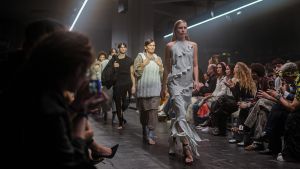





HFDA Academy: New View | Episode 11| Challenges and innovative solutions in the creative industry

Consumer habits never changed as fast and as dramatically as they do today, so it is extremely important for brands to make carefully considered strategic decisions about their communications, sales platforms, and digital presence. If they are able to recognize the opportunities inherent in the changed economic situation, they can even come out of this period as winners.
The question of adaptation: How have consumer habits changed?
The pandemic and the accompanying health precautions have irreversibly changed consumer habits. In recent months, it has been proven that there is always some external factor that motivates consumers to visit a clothing store, hence events and family occasions can be considered the driving forces of fashion. Events, like all other ordinary things, have undergone great transformations, so people prepare for them by taking other aspects into account. When there is a major change in the lives of consumers, certain patterns of behaviour remain with them permanently - including the way they think about their budget or lifestyle. Once online shopping has become a natural part of people’s everyday lives, they may not want to give it up in the future either - after all, they’ve learned the positives that accompany this consumer habit. The most important question for the coming period, therefore, will be, what is worth leaving their homes for?
Changes in fashion industry practices
Like other sectors, the business practices of the fashion industry are being re-evaluated: some come to the fore, others are pushed into the background or even disappear altogether. All of this can already have an impact on the work schedules of fashion companies: it can easily happen that working from home and thus the division of work in the online space is gaining more space in everyday life. Recent months have highlighted that it is much more effective to negotiate with co-workers and clients through online meetings, which can reduce the frequency of business trips - after all, there is now evidence that geographical distances can be easily bridged at work.
The coming period may also bring big changes to the promotion of fashion brands. Until the pandemic, fashion weeks were the number one selling opportunity for fashion designers. In some countries, including France, a shift in attitudes towards brand promotion has begun. Saint Laurent, for example, recently announced that although the October fashion shows are lagging behind, it intends to help the brands ’digital presence with a number of new tools. This perception is expected to have an impact in other countries as well, which could open new doors for fashion brands. As a result of the pandemic, customers are now available not only in the busiest parts of big cities but also in their homes, bringing them closer together than ever before.
A change in attitudes towards consumers
As a result of the crisis, it has become natural for consumers to develop much deeper relationships with companies which they spend more time with. Fashion companies with a multi-channel sales strategy were able to provide a higher level of experience to their consumers by providing more personalized service to their audiences compared to their competitors thanks to the benefits of digitalization. All of this has pointed out that the next level of development for fashion brands could be improvements to the exchange or return of products purchased online. We can already see examples of this at the moment - including Nordstrom, which has even set up a store in Manhattan where products from other brands can be returned. This is also a good example of the fact that a strong relationship with consumers also eliminates the threat posed by competitors.
One of the positive contributions of the pandemic has been the emergence of strong brand communities. It is now clear that people want to make a real and valuable connection with the brands they buy from. It is, therefore, the task of fashion brands to have a meaningful and credible dialogue with their consumers. The pandemic has made brands realize that, in addition to their customers, their employees are also part of their community. For the first time in the world of social media, fashion brands have focused on their employees, many of whom may have even lost their jobs in recent months. This is a particularly sensitive issue that is still worth discussing - consumers are sympathetic to a brand taking responsibility for its employees. Burberry and Ralph Lauren, as well as Fenty’s Rihanna, have proved exemplary in this, taking on much more social responsibility and significant charitable donations, making them proud of their entire brand community. Pride is a motivating force that strengthens every relationship - be it consumers or employees.
A change of attitude in business collaborations
In recent months, we have witnessed countless excellent collaborations on social media. Glossier, for example, tried out the new hand cream with nurses before its release, which was highly appreciated by followers, despite being very different from donations. Also, examples to follow are Zara and Balenciaga, who have proven to be very quick in promoting the #stayhome movement on social media by inviting influencers and their customers to wear and share photos of their products. In addition, they also published their price list of products on their e-commerce platforms very quickly.
How can domestic brands adapt?
There are several ways for Hungarian brands. Smaller brands, which are still in the early stages of development, have not yet invested heavily in infrastructure and therefore do not need to redesign it. Sustainability brands can now come to the fore - it’s worth looking at how they can live up to sustainability and rethinking what and how to spend. Brands with a larger consumer base deserve special attention to how they segment their customers in their e-commerce operations. Brands moving up the curve have no reason not to be able to continue their development.
A summary of the pro-publication in English is also available in a downloadable form here.
More articles

The Hungarian Fashion & Design Agency Continues Its Operations Under the Name Creative Hungary Nonprofit Zrt.

BCEFW Young Talents Designers Featured in the Design POP-UP by ELLE Selection