




“Beauty Springs From Inner Harmony” – an Interview With Enikő Sütő
Enikő Sütő entered the profession in the latter half of the 1970s, as part of the second generation of Hungarian fashion models, and quickly achieved great success. Barely six months into her career, she was already appearing on both Hungarian and international catwalks, later featuring on large-scale street posters as the face of the Fabulon brand. She also worked as a lawyer and in the international cosmetics market, and with the modelling school she founded in 1989, she ensured professional training and continuity in Hungary for three decades. In this Fashion Icons interview, held in connection with the 16th season of BCEFW, she spoke about the atmosphere of Hungary’s fashion scene in the 1970s and ’80s, the challenges of generational change, the psychological aspects of modelling, and the importance of self-awareness for women.
“There was a time, even just ten years ago, when everything was about the new and the young. Now, however, [...] fashion is reaching back to those who are young at heart, and who have the means, the time and the awareness to take care of themselves.”
Your name is linked with (one of) the golden ages of Hungarian modelling culture. What memories do you hold from that time?
In 1978, I was chosen as Model of the Year, even though I had only been on the catwalk for six months. At that time, women were not presented as some distant beauty locked away in a showcase, but rather as figures of everyday life – in schools, in markets, on the runway. The daily presence and gestures of models were themselves considered admirable. For me, this role already carried a sense of social responsibility, even if I wasn’t consciously aware of it then. I felt that those who appeared on the catwalk held a kind of elevated status – one that was met with a curious, ambivalent attitude, much like that experienced by actors.
Did you follow fashion trends more closely back then?
At the time, the choice was far more limited – not just in variety but in quantity as well. If I think back to my own wardrobe, when I first started working as a model, I had only two pairs of jeans and perhaps four or five T-shirts. For one of the auditions at the Rotschild Salon, fifty girls were invited, and only two of us were selected for the big show. I had rushed in straight from university, wearing jeans and a hooded sweatshirt, when in fact such an occasion called for an elegant appearance. I overheard some of the ladies whispering, “Which one did they pick?” – “That one, the hooded Father Christmas.” That was me. I was very much aware that I had to catch up with the fashion world – and by the time I was awarded Model of the Year, I was already travelling abroad, where I had to buy my clothes to meet both domestic and international expectations.
Was there a single iconic garment in your youth that played a defining role in shaping your later style and taste – perhaps the jeans you mentioned?
Without a doubt, the jeans! I’ve often thought about why they became my trademark – perhaps because I became popular through a poster where I was wearing denim, and later people came to associate me with that garment. I bought my first pairs at the Ecseri market – that was the only way to get hold of Western jeans. Don’t think it was easy! I loved the Super Rifle and Roy Rogers brands; Levi’s, however, was too heavy for me, as it didn’t suit me. A pair could cost as much as 1,500 forints – at a time when the average monthly wage was between 400 and 1,000 forints (though I should add, I wore those jeans for many, many years). Later, Hungarian companies also tried their hand at denim – for example, Trapper appeared, but the fabric was rigid and uncomfortable to wear. Then came stonewashed and hand-faded jeans, which were much closer to what we really wanted.
Since you mention your famous denim fashion photo, your Fabulon poster is preserved as an iconic image in fashion history. How do you relate to that photograph today?
At the time, it was something quite new – to walk out into the streets and see the city plastered with my pictures. Often I feel as though it’s not even me in that photo – it seems so distant, as if it belonged to another life, when I was still just a girl. In time, one realises that while you are trying to define yourself, others are also defining you. Many things that were important to me never appeared during that period – for example, the fact that I was studying law was just as central to my identity. In truth, I have dedicated my whole life to showing that every woman should dare to be sensitive, while at the same time being intelligent. To be honest, that era was an important milestone in my life, one that continued with the modelling school – although that was an entirely different dimension and a far greater responsibility. The photograph was undoubtedly a breakthrough moment, but for me, it never became the focal point. It was more like a gift from life, which I accepted with gratitude, but I never built everything around it.
And was there ever a time when these two worlds – modelling and the legal profession – came together, perhaps in your school as well?
Yes, very much so. And they fitted together well – not only because I taught the students professional knowledge about contracts and management issues, or answered legal questions raised by their parents, but also because through my own person I was able to set an example: not to remain at the surface, not to get stuck on appearances, but to fill what they represent with real substance.
Speaking of teaching: for decades, you’ve played a defining role in training the next generation of professionals. What do you consider most important today in educating a young model?
Over the past twenty years, I’ve placed increasing emphasis on making students understand that a model is not a “coat hanger” – she has dignity, free will, and the right to shape her own destiny. She can choose which assignments to accept and consciously avoid situations of vulnerability. I saw that this was often their greatest struggle: either they desperately tried to please and grew exhausted, or they gave up and were sent home. We welcomed many different types and age groups, but these lessons proved useful at any stage of life: some struggled with low self-confidence, others wanted to become actresses and needed to learn how to manage their appearance. Of course, some arrived with a true model’s physique – and they did become models, such as Pamela Hódi, Andrea Sicra or Linda Szunai (Miss World Hungary 2011). Even today, I enjoy seeing them on television, and it gives me joy to know that at the age of 12, 13 or 14, I could give them the very first impulse that has stayed with them throughout their lives.
So you’ve played a defining role in the careers of many of your students – but can you recall an encounter that taught you a great deal as well, and had a strong impact on you?
When I was fourteen, Ági Pataki was already at the peak of her career – her talent and beauty were exceptional, but what inspired me most was her radiant personality. Later, I was captivated by Anna Safranek’s movement, and then there was Piroska Lantos, with whom I often worked. Sometimes, only the two of us were chosen for a show, which was unusual, as at 180 cm, she stood out completely from the Hungarian scene. At home, she mostly appeared on magazine covers; the Hungarian fashion world didn’t quite know what to do with her, but abroad – especially in New York – she was called “the most beautiful woman”. Her freedom absolutely fascinated me: on the runway, she always walked her own way, never allowing herself to be “staged”. In Hungary, this often provoked resistance, but abroad, she was particularly appreciated for it. From the profession, I also must mention Tamás Náray – I greatly valued his intellect, his vision, and the perspective he brought back from his studies abroad, which was something of a rarity at the time.
And since you’ve mentioned some important names from the modelling world: what does it feel like to see those with whom you practically grew up, or with whom you shared the most important milestones of your career, now returning to the catwalk? Do you think it’s important that older, more experienced models also have a place on the runway?
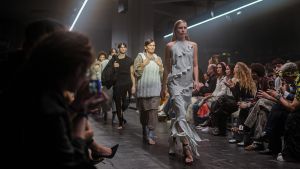
I really like this phenomenon. At the winter Budapest Central European Fashion Week, for example, I didn’t meet models of my own generation, but slightly younger ones who now work in Paris. With grey hair, fine wrinkles, looking beautiful and confident, and still in demand today, making a living from the profession. I see this as a sign of the younger generation’s openness. There was a time, even just ten years ago, when everything was about the new and the young. Now, however – perhaps also for business reasons – fashion is reaching back to those who are young at heart, and who have the means, the time and the awareness to take care of themselves. This is inspiring not only for them, but also for the young. I often talk with women in their forties who are afraid of ageing, and these models show that loveability also lies hidden in imperfection. Whether I myself would do it is another question, but I really enjoy watching. It’s wonderful to see that today beauty can have so many different faces.
More articles
The Hungarian Fashion & Design Agency Continues Its Operations Under the Name Creative Hungary Nonprofit Zrt.

BCEFW Young Talents Designers Featured in the Design POP-UP by ELLE Selection